

Business Professional Focus: Ensuring all investments and initiatives align with strategy #
In today’s data-driven business environment, organizations operate in an increasingly complex ecosystem of competing priorities, evolving markets, and accelerating digital transformation. Business leaders and consultants alike face the challenge of translating strategic intent into measurable action while maintaining agility and accountability.
Achieving this requires not only clear strategic direction but also transparent governance, data intelligence, and real-time insight into how every initiative contributes to enterprise value.
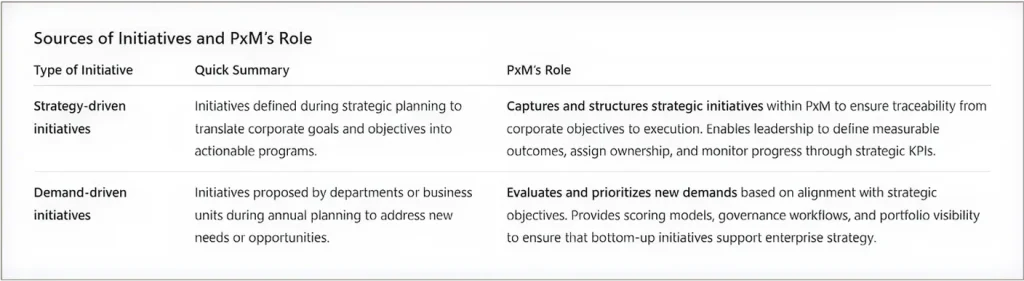
In practice, this means understanding where initiatives originate and how they connect back to strategy. Organizations pursue countless initiatives to deliver value, drive growth, and achieve transformation. These initiatives often originate from two primary sources:
- Strategy-driven initiatives – defined during the formulation of the organization’s strategy, when leadership identifies goals and objectives and builds a roadmap of initiatives to bring that strategy to life.
- Demand-driven initiatives – generated organically across departments and business functions during annual planning cycles, as teams propose new projects or investments to address emerging needs or opportunities.
In both cases, alignment with the overall strategy is critical. PxM’s Strategy Management module ensures that every initiative – whether born from top-down strategic planning or bottom-up functional demand – contributes meaningfully to organizational objectives.
With a clear link between strategic intent and execution established, PxM operates as a role-based ecosystem. Multiple stakeholders – such as PMO Leaders, Portfolio and Project Managers, CFOs, CTOs, and Strategy and Performance Officers – each interact with the platform according to their specific goals and responsibilities. Through this collaborative environment, they make investment decisions that are transparent, data-driven, and aligned with business priorities.
What Strategy Management in PxM is: Balanced Scorecard framework for defining strategies, perspectives, objectives, and KPIs #
PxM’s Strategy Management Module is built on a Balanced Scorecard framework that enables organizations to translate strategic vision into actionable, measurable objectives. It provides a structured approach for defining strategies, perspectives, objectives, and key performance indicators (KPIs) that connect every level of the enterprise – from corporate leadership to individual contributors – within one unified system.
The module supports managing strategic, corporate, departmental, and individual objectives. At the highest level, executives define the corporate strategy and long-term goals that guide the organization’s direction. PxM then allows these objectives to be cascaded to departments, programs, and even individual roles, ensuring that each team’s activities directly contribute to the achievement of enterprise goals.
By linking perspectives such as financial sustainability, business capability growth, customer experience improvement, innovation and competitive advantage, PxM provides a holistic view of how success is measured and sustained. Business users can:
- Define and structure objectives across different perspectives and hierarchy levels.
- Set measurable KPIs that reflect progress toward each objective.
- Cascade and align goals to maintain visibility and accountability across the organization.
- Monitor and update performance dynamically as strategies evolve.
Key benefits of Strategy Management and alignment in PxM #
Through PxM, strategy management becomes a continuous governance process rather than a static annual exercise. The platform helps organizations:
- Connect strategy to execution, translating goals and objectives into actionable portfolios and projects.
- Evaluate new demand requests against strategic criteria, ensuring that only initiatives aligned with the company’s vision are approved.
- Maintain enterprise-wide alignment, where every investment, project, and resource allocation supports measurable strategic outcomes.
Ultimately, PxM enables organizations to manage the entire strategy value chain within a unified system – from strategic planning, through portfolio and project execution, to performance tracking and benefit realization. This integrated, role-aware environment ensures that every persona – whether defining long-term objectives, prioritizing investments, or assessing outcomes – has the visibility, tools, and insights needed to make data-driven decisions that align with enterprise priorities and deliver measurable business value.

